Quick Answer
- Dubai property correction 2026 is real but modest, with prices down 4–10% from peak on geopolitical factors.
- Residential capital values remain up 8.9% year-on-year despite the quarterly dip, per ValuStrat Q1 2026 data.
- H1 2026 transactions hit AED 225.7 billion, confirming this is a calibration, not a crash.
- Sydney yields average 3.1% in 2026 versus Dubai’s 6.5–8%, making the dip a buying window for Australians.
- Strong areas including JVC, Dubai Hills, and Dubai South continue to outperform the broader market pullback.
Sydney investors watching Dubai headlines in 2026 are seeing two things at once: price dips and record transaction volumes. That combination is not a contradiction. It is a buying signal. The Dubai property correction 2026 is real, driven by a geopolitical shock and a supply cycle, but it is also measured, with values still firmly above where they stood twelve months ago.
The problem is that most Sydney investors cannot tell the difference between a market in freefall and a market taking a breath. One demands caution. The other demands action. This article gives you the data to know which is which, and the framework to decide whether now is the right time to move.
You will learn what caused the 2026 dip, how deep it actually goes by property type and location, how Dubai’s fundamentals compare to Sydney’s, which areas still offer yield and growth, and what steps Sydney investors should take before the market firms up again.
What Actually Caused the 2026 Dip?
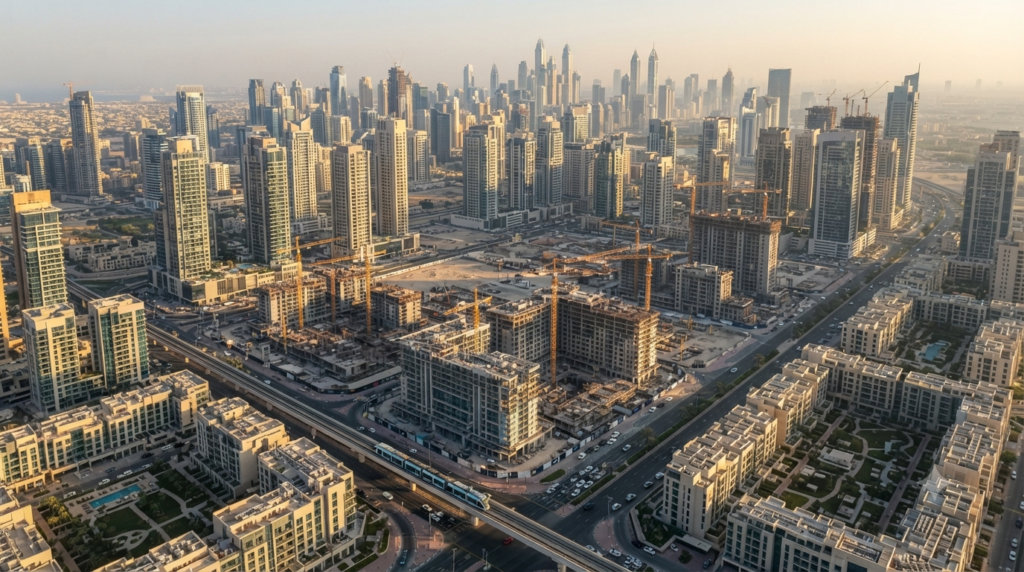
The Dubai property correction 2026 has two distinct engines, and it is critical to understand both before drawing conclusions about where the market goes from here.
The first engine was geopolitical. When Iranian projectiles struck UAE targets on 28 February 2026, regulators ordered the DFM exchange closed for two days. When trading resumed, the General Index fell 4.7% in a single session, and the DFM Real Estate Index fell approximately 21% in the two weeks that followed. That is a sentiment shock, not a structural failure.
Geopolitical Trigger
Dubai’s residential real estate market showed resilience despite the geopolitical tensions, with housing transactions worth AED 225.7 billion recorded in H1 2026. While the Iran conflict briefly impacted buyer sentiment during March and April, the correction was largely driven by market psychology rather than weakening fundamentals.
To put that in context: during the Global Financial Crisis between 2008 and 2010, residential prices declined by nearly 40% and took three and a half years to recover. During COVID-19, prices fell around 6% before recovering within 13 months. The Iran conflict in 2026 resulted in a relatively modest 4–7% correction.
This is the smallest geopolitical impact Dubai has ever recorded. For Sydney investors with a two-to-five year horizon, a 4–7% dip against a market still sitting 8.9% above its year-ago value is context, not alarm.
Supply Cycle Factor
After a surge of nearly 60% in residential property prices between 2022 and Q1 2025, Dubai is seeing a significant influx of new housing units, with approximately 250,000 units slated for delivery between 2023 and 2026, and a peak of 120,000 units expected in 2026 alone. This supply wave was always coming. The geopolitical shock simply arrived at the same time.
While up to 120,000 new units are scheduled for handover, historically only about half are delivered on time. The effective supply landing in 2026 is therefore likely closer to 60,000 units, which is large but absorbable given Dubai’s continued population inflows.
Sentiment vs. Structural Reality
Here is the key distinction every Sydney investor needs to understand before interpreting the Dubai property correction 2026:
| Factor | What It Suggests | What It Actually Means |
| DFM Real Estate Index fell 21% | Panic selling on exchange | Liquid stock is not physical property |
| Residential prices down 4–7% | Major correction underway | Erases six months of rapid growth only |
| Transaction volumes down 25% in March | Demand collapse | Buyers pausing, not disappearing |
| Annual prices still up 8.9% (ValuStrat) | Market still in growth | Short-term dip within longer uptrend |
| H1 2026 transactions: AED 225.7 billion | Deal flow collapsed | Still one of the strongest half-years on record |
The numbers tell a story of a market recalibrating, not reversing. That distinction is everything for a Sydney investor deciding whether to act or wait.
How Deep Is the Correction by Area?
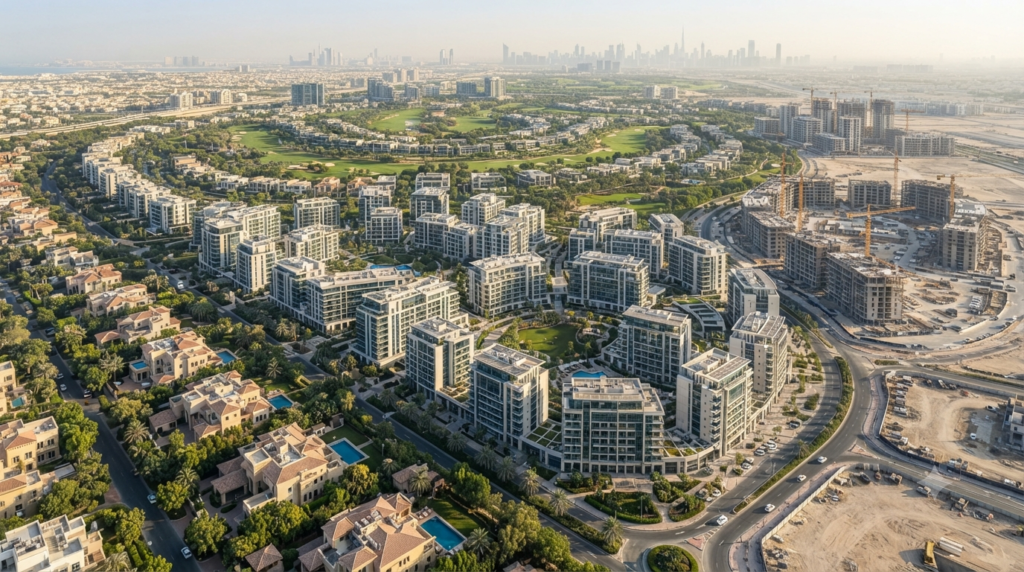
Not every part of Dubai is correcting equally. The Dubai property correction 2026 is concentrated in specific segments and communities. Understanding the geography of the dip is as important as understanding its cause.
The correction was broad-based initially, with villa values down 5.8% and apartments falling 6.3% over March 2026. Among villas, Arabian Ranches Phase 2 (-11.5%) and Dubai Hills Estate (-10.8%) recorded the steepest monthly declines. However, those numbers reflect the immediate shock month, not the ongoing trajectory.
Areas Seeing Larger Drops
The communities most affected by the Dubai property correction 2026 share a common profile: high off-plan completion volumes, elevated investor-to-end-user ratios, and limited differentiation between competing buildings.
- Newer off-plan developments in fringe locations with heavy stock overlap
- Mid-market apartment buildings in areas like JVC where supply from 2023 launches is now landing
- Secondary-market sellers with outstanding mortgages or forced exit timelines
- Luxury apartments in Downtown Dubai and Dubai Marina, where prices ran hardest in 2023–2024
Understanding which communities face the greatest correction risk helps investors make more informed decisions. Comparing supply levels, demand, and long-term fundamentals can reveal where stronger opportunities still exist despite market adjustments.
Areas Remaining Resilient
The strongest yearly gains within the villa segment were concentrated in Jumeirah Islands (17.9%), Emirates Hills (10.7%), The Meadows (10%), The Villa (7.8%), and Reem (5.7%). These communities have established infrastructure, low turnover, and owner-occupier demand that buffers against sentiment shocks.
Rental yields in JVC can exceed 7% in 2026, making it one of the strongest growth corridors for yield-focused investors. Dubai Hills Estate is considered one of the safest long-term residential investments heading into 2026, with golf course and park-facing units driving premium pricing.
Area Performance Comparison
| Area | Correction Depth | Yield (2026) | Recovery Outlook |
| Emirates Hills (villas) | Minimal | 4–5% | Stable, owner-occupier demand |
| Jumeirah Islands | Minimal | 5–6% | Strong, limited supply |
| Dubai Hills Estate | Moderate (10.8% monthly peak) | 6–7% | Recovering, family demand |
| JVC (apartments) | Moderate | 7–8% | Stable yield, high tenant demand |
| Downtown Dubai (apartments) | Elevated | 4–5% | Slow recovery, high supply |
| Arabian Ranches Phase 2 | Elevated (11.5% monthly peak) | 4–5% | Longer recovery timeline |
| Dubai South | Low | 7–9% | Infrastructure-driven growth |
For Sydney investors, this table makes the selection strategy clear. The correction has created entry points in Dubai Hills and JVC that did not exist twelve months ago. It has also exposed which areas carry structural risk and which carry only sentiment risk.
From years of advising investors across Sydney, the buyers who navigate corrections best are those who already know their target area and can act quickly when short-term sellers create windows that close fast.
How Does Dubai Compare to Sydney in 2026?

The Dubai property correction 2026 only matters in context. For Sydney investors, the context is their home market, and the comparison is not flattering to Australia.
Sydney records the lowest gross rental yield of any Australian capital city at 3.1% in Q1 2026, with quarterly price declines of 0.2%. That combination of low yield and falling prices is exactly the environment that drives capital toward higher-performing alternatives. According to Khaleej Times, average rental yield in Dubai continues to sit between 6% and 8% in 2026, depending on location and demand strength.
Yield & Return Comparison
Even after the Dubai property correction 2026, the yield gap between the two markets remains stark. Consider what AUD 700,000 (approximately AED 2 million) buys in each market today:
| Metric | Sydney (2026) | Dubai (2026 post-dip) |
| Gross rental yield | 3.1% | 6.5–8% |
| Annual rental income | ~AUD 21,700 | ~AUD 45,500–56,000 |
| Capital gains tax (on profit) | Yes, ATO applies | Zero (UAE side) |
| Annual property/land tax | Yes (state-dependent) | Zero |
| Entry point for AUD 700K | Small apartment, outer suburb | Positioned for Golden Visa eligibility |
| Golden Visa eligibility | No equivalent | Yes, at AED 2M investment |
AUD-AED Currency Angle
The UAE Dirham is pegged to the US dollar, meaning that if the Australian dollar weakens against the USD, the value of the Dubai asset effectively increases when converted back to Australian currency. In 2026, with AUD under pressure from domestic economic softness, this peg works in favour of Sydney investors who hold Dubai assets. A depreciating AUD amplifies Dubai returns when converted home.
Additionally, Dubai promotes a 0% personal tax environment, with no personal income tax, no capital gains tax on property sales, and no recurring land tax. However, the Australian Taxation Office still treats foreign rental income as assessable worldwide income for Australian tax residents. Factor in your ATO obligations, but also factor in that gross-of-tax Dubai returns start from a much higher base, leaving considerably more in your pocket even after Australian reporting.
What Should Sydney Investors Do Now?

The Dubai property correction 2026 has created a specific window. It will not stay open indefinitely. June 2026 data shows a major month-on-month surge of 46.8% in ready property sales, marking the strongest monthly growth in three years, indicating that capital adjustments are successfully unlocking pent-up investor demand. Buyers are already moving.
Act or Wait Strategy
The decision to enter now versus wait depends on three factors:
- Your target property type: Ready properties are recovering fastest. Off-plan developments in oversupplied corridors may see further softness.
- Your hold horizon: A five-year or longer hold absorbs the current dip completely based on historical precedent. A one-to-two year horizon carries more timing risk.
- Your yield priority: If rental income is your primary goal, JVC and Dubai South currently offer the strongest net yield relative to entry price.
Your investment timeline and objectives should guide your decision more than short-term market movements. Matching the right property with your strategy can improve both returns and long-term confidence.
Steps to Take Right Now
Sydney investors who want to act on the Dubai property correction 2026 should follow this sequence:
- Get ATO-compliant advice on overseas property income and capital gains reporting before committing funds
- Shortlist two or three target areas based on yield priority versus capital growth priority
- Understand the developer payment plan structures offered by Emaar, DAMAC, Binghatti, and Imtiaz to assess which aligns with your cash flow
- Use the Dubai Property Expo Sydney as a face-to-face event to compare developer offers, verify RERA registration, and meet licensed agents
- Confirm escrow account numbers for any off-plan project before signing a Sales and Purchase Agreement
- Engage a UAE-licensed mortgage broker if you plan to use finance at handover
What we have consistently observed with Sydney investors who enter during correction windows is that those who prepare their structure before the window closes capture the best combination of entry price, developer flexibility, and yield setup. Those who wait for confirmed recovery pay the premium for hindsight.
Ready to Invest in Dubai from Sydney?
Sydney investors are seeing two things at once in 2026: modest price corrections and record transaction activity. That combination is not a warning sign. It is an opportunity for buyers who understand the difference between a short-term market adjustment and a long-term investment trend.
The Dubai property correction 2026 has been driven by temporary geopolitical uncertainty and a planned supply cycle, yet residential values remain well above last year’s levels. Investors who prepare early can secure stronger entry prices before competition increases as the market continues to recover.
Register for the Dubai Property Expo Sydney today to meet verified Dubai developers, compare live project pricing, and position yourself before ready-property transaction volumes confirm the recovery that the data already suggests is underway.
Frequently Asked Questions
Is Dubai property crashing in 2026?
No. The Dubai property correction in 2026 is a market adjustment rather than a crash, with prices declining only modestly before estabilising. Transaction activity remains strong, supporting long-term market confidence.
What caused the Dubai property dip in 2026?
The correction was driven by geopolitical uncertainty and a large wave of new property completions. Together, these factors temporarily slowed demand and created selective price adjustments instead of a market-wide decline.
Which Dubai areas are most affected by the correction?
Areas with high off-plan supply and strong investor activity have seen the biggest price pressure. Established communities with limited supply and strong end-user demand have recovered more quickly.
Is now a good time to buy Dubai property from Sydney?
For long-term investors, current market conditions present an attractive buying opportunity. Choosing the right location and developer is more important than trying to perfectly time the market.
How do Dubai property yields compare to Sydney during the correction?
Dubai continues to offer higher rental yields than Sydney, typically ranging from 6% to 8%. Combined with its tax advantages, it remains an attractive option for Australian property investors.