Quick Answer
- Dubai vs Sydney property in 2026 favours Dubai for pure cash flow
- Dubai gross yields run 6 to 10%, versus Sydney’s 2.5 to 3.5%
- Sydney entry costs start above AUD 1.28 million for a median house
- Dubai apartments start near AUD 300,000, with only a 4% transfer fee
- Sydney still wins on capital growth history and zero currency risk
Every Sydney investor eventually asks the same question: is my next deposit better spent chasing Sydney’s growth story, or put to work somewhere it earns more from day one? In 2026, that question has a clearer answer than most people expect, and it comes down to a straightforward trade-off between cash flow and capital growth rather than one market being universally “better.”
Dubai vs Sydney property comparisons consistently show the AUD working harder in Dubai on nearly every income metric, while Sydney retains the edge on long-term capital appreciation and currency stability. This guide lays out the actual numbers side by side, rather than relying on general reputation, so you can decide which trade-off suits your own strategy.
What follows covers entry prices and upfront costs, rental yields and mortgage rates, a real cash-flow example using a fixed AUD budget, and the capital growth case that still keeps investors loyal to Sydney. By the end, you’ll have a clear framework for deciding where your next dollar should actually go.
What Does Each Market Cost?

Dubai vs Sydney property starts with a wide gap before you even factor in ongoing returns, and the entry price alone changes who can realistically participate.
Entry Price Comparison
Sydney’s median dwelling value sits above $1.28 million, according to Cotality’s most recent home value index, with houses trending even higher than that combined figure. Dubai apartments, by comparison, start around AUD 300,000 to 600,000 in strong-yield districts like Jumeirah Village Circle, putting a comparable entry point within reach of far more Sydney-based buyers.
Upfront Buying Costs
Sydney adds substantial friction on top of the purchase price. Foreign buyers face NSW transfer duty plus an additional surcharge purchaser duty of 8 to 9%, administered through Revenue NSW, alongside a Foreign Investment Review Board application fee that can run into the tens of thousands of dollars on a typical apartment purchase.
- Dubai’s principal acquisition cost is a flat 4% Dubai Land Department transfer fee
- Sydney’s combined stamp duty and foreign surcharge alone can exceed 10 to 17%
- FIRB application fees in Sydney scale with price and can reach AUD 45,000+
- Dubai has no annual property tax, land tax, or FIRB-style approval process
Total closing costs for foreign buyers in Sydney commonly land between 14 and 18% of the purchase price.
Ongoing Tax Exposure
Sydney property carries recurring costs well beyond settlement. Foreign owners of NSW residential land face an annual surcharge land tax, plus standard income tax on rental profits and capital gains tax on any eventual sale. Dubai charges 0% personal income tax, 0% capital gains tax, and no annual property tax at all, a structural difference that compounds significantly the longer you hold the asset.
Entry costs and ongoing taxes tell only half the story though. What actually determines whether your AUD works harder comes down to what each property pays you back every year, which is where the yield gap becomes impossible to ignore.
How Do Yields Compare?
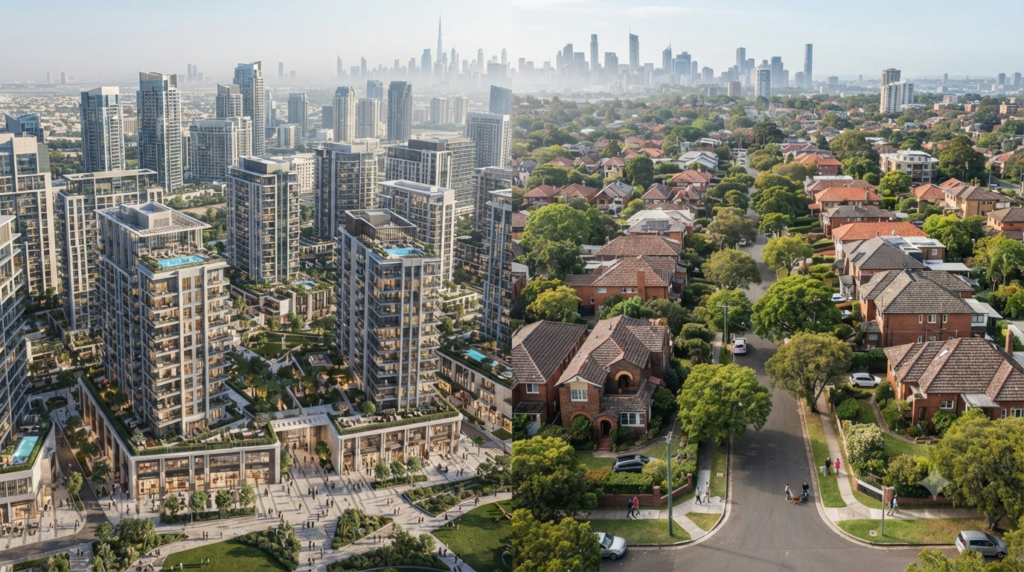
The income side of Dubai vs Sydney property is where the two markets diverge most sharply, and it’s the single biggest factor pushing cash-flow investors toward the Gulf.
Dubai Rental Yields
Gross rental yields across Dubai typically range from 6 to 10%, with high-demand districts like JVC, Dubai Marina, and Business Bay regularly clearing 8% or higher. Best Areas to Buy Property in Dubai for Sydney breaks down which specific communities perform best for yield-focused buyers entering at different price points.
Sydney Rental Yields
Sydney’s gross rental yields sit at a comparatively modest 2.5 to 3.5%, among the lowest of any Australian capital city. That compression is a direct byproduct of Sydney’s high entry prices relative to achievable rents, a dynamic that has persisted through multiple property cycles rather than being a temporary anomaly.
Mortgage Rate Gap
Financing costs widen the gap further. Dubai mortgage rates for qualifying buyers run approximately 4.5 to 5.0% fixed, while Sydney variable rates for investors currently sit near 6.4 to 6.5% following the Reserve Bank’s rate hikes earlier in 2026.
| Feature | Dubai | Sydney |
| Median entry price | ~AUD 300K–600K (apartments) | AUD 1.28M+ (houses) |
| Gross rental yield | 6% to 10% | 2.5% to 3.5% |
| Upfront buyer costs | 4% DLD fee | 10%+ (duty, surcharge, FIRB) |
| Ongoing taxes | 0% property/rental tax | Land tax, income tax, CGT |
| Mortgage rates | ~4.5%–5.0% fixed | ~6.4%–6.5% variable |
Lower entry costs, higher yields, and cheaper financing all point the same direction on paper. Running these numbers against a real, fixed AUD budget makes the practical difference even clearer.
Comparing yields, financing costs, and purchase expenses provides a clearer picture than looking at property prices alone. When these factors are assessed together, investors can better understand which market aligns with their income goals, long-term growth strategy, and available budget.
Where Does Cash Flow Win?

Comparing headline percentages only goes so far, so it helps to run both markets through the same AUD budget and see what actually comes out the other end.
Sample Investment Math
An AUD 500,000 deposit stretches meaningfully further in Dubai than in Sydney, where it barely covers a deposit on a median house rather than a full purchase. In a high-demand Dubai district, that same amount can fund a complete apartment purchase generating immediate net rental income rather than years of waiting for capital growth to materialise.
Take-Home Pay Gap
The income advantage extends beyond property into salary too, which matters if you’re weighing a relocation alongside the investment decision. At an AUD 200,000 salary, take-home pay in Dubai runs roughly AUD 68,000 higher per year than in Sydney once Australia’s progressive tax brackets and 2% Medicare levy are applied, based on current ATO rate schedules.
Reinvestment Potential
That combined gap, higher rental yield plus higher take-home income, compounds quickly for investors actively reinvesting profits. A Sydney couple documented in a recent case study reinvested Dubai rental income directly against their Australian mortgage, shaving years off the loan term using cash flow that a comparable Sydney property simply couldn’t generate.
- A senior engineer earns roughly AUD 68,000/year more net income in Dubai
- A lawyer at senior associate level nets approximately AUD 61,000/year more
- A management consultant sees the widest gap, at AUD 82,000/year more
- These figures exclude property yield, which widens the total gap further
Cash flow this strong is the core argument for Dubai, but it isn’t the whole picture. Sydney investors haven’t stuck around for decades without reasons of their own, and those reasons deserve equal weight.
Strong cash flow can accelerate wealth building, but it should never be the only factor guiding an investment decision. Looking beyond income to consider stability, lifestyle, and long-term growth provides a more balanced comparison between Dubai and Sydney.
What About Capital Growth?
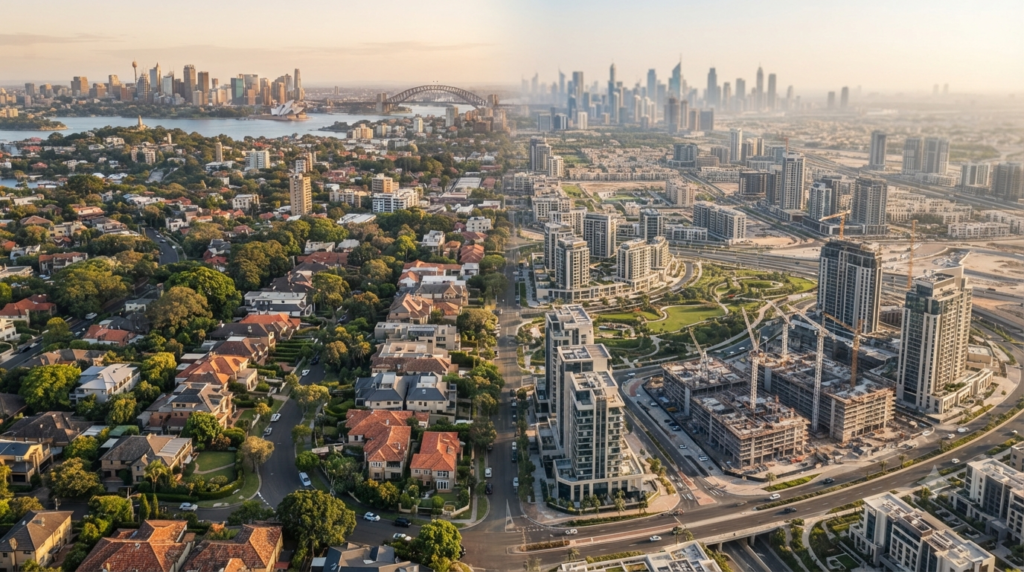
Dubai vs Sydney property isn’t purely a yield contest, and long-term capital appreciation remains the strongest counterargument in Sydney’s favour.
Sydney Growth Case
Sydney has delivered a strong long-run growth trajectory over the past decade, surviving multiple correction cycles and rebuilding momentum each time. Structural undersupply, a tight rental vacancy rate, and sustained population growth of more than 100,000 residents annually continue to underpin the argument for holding Sydney property as a long-term capital growth asset rather than a cash-flow vehicle.
Dubai Growth Case
Dubai’s appreciation story is younger and more cyclical by comparison, tied closely to tourism cycles, infrastructure expansion, and government-led development targets. Dubai Investment Properties covers which specific project types have historically shown the strongest combined yield-and-growth profile for investors who want some of both.
Currency Risk Factor
Every dollar invested in Dubai carries AUD/AED currency exposure that a Sydney property simply doesn’t. The dirham is pegged to the US dollar, meaning your effective return depends partly on how AUD moves against USD over your holding period, a variable Sydney investors never have to model.
Neither growth story cancels the other out entirely, which is exactly why the right answer depends on what you’re actually optimising for. That’s the real decision this comparison should help you make.
Which Market Fits You?
Dubai vs Sydney property ultimately comes down to matching the market to your specific financial goal, not picking an objectively “better” city.
Cash Flow Investors
Investors prioritising immediate income, lower entry barriers, and minimal ongoing tax drag will find Dubai the clearer fit. Off Plan Dubai Property: How Sydney Investors Get In Early explains how staged payment plans make entry even more accessible for investors starting with a smaller upfront deposit.
Growth-Focused Buyers
Investors who value long-run capital growth, zero currency risk, and Australia’s institutional stability will still find good reasons to stay in Sydney, even accepting the lower yield and higher entry cost that comes with it.
Golden Visa Angle
Purchases from AED 2 million, roughly AUD 850,000, unlock a 10-year UAE Golden Visa for the buyer and their family. Dubai Golden Visa Property: The Complete Guide explains exactly how this threshold works and why it’s becoming a deciding factor for larger Sydney investors weighing both markets at once.
Whichever profile fits you, the underlying math in this guide holds regardless of budget size. What changes is simply how much weight you place on cash flow today versus growth over the next decade.
Where Should Your AUD Go?
The numbers in this guide point in a consistent direction: Dubai vs Sydney property in 2026 favours Dubai decisively on cash flow, entry cost, and ongoing tax exposure, while Sydney still holds the edge on long-term capital growth and currency stability. Neither market is wrong, but most investors are better served picking based on which outcome they actually need rather than which city sounds more familiar.
For investors focused on maximising income from a fixed AUD budget, Dubai Freehold Properties and Purchase Property in Dubai are the logical next steps, while Sydney remains the stronger choice for buyers prioritising long-run domestic growth over immediate yield.
Explore current Dubai property opportunities at dubaipropertyexposydney.com.au and book a free consultation to see exactly where your AUD works hardest.
Frequently Asked Questions
Is Dubai property actually cheaper than Sydney property?
Yes, on a straight entry-price basis. Dubai apartments in strong-yield districts start around AUD 300,000 to 600,000, while Sydney’s median house value sits above AUD 1.28 million. Even accounting for currency conversion and transaction costs, Dubai’s lower price point puts ownership within reach of a much wider range of Sydney-based investors.
Which market gives better rental returns, Dubai or Sydney?
Dubai wins clearly on gross rental yield, typically running 6 to 10% compared with Sydney’s 2.5 to 3.5%. The gap widens further once you factor in Dubai’s zero personal income tax on rental earnings, versus Australia’s marginal tax rates applying to Sydney rental income. Is Dubai Investment Property Safe? covers the regulatory protections behind these returns.
Do foreign buyers face restrictions purchasing in Sydney?
Yes, significantly. Foreign buyers currently face an 8 to 9% surcharge purchaser duty in NSW on top of standard stamp duty, plus FIRB approval requirements, and are largely restricted to new or off-plan dwellings rather than established homes under current federal policy. Dubai imposes no equivalent foreign-buyer restrictions or surcharges of any kind.
Does buying property in Dubai affect my Australian tax obligations?
Yes, Australian tax residents must still declare Dubai rental income on their ATO return, even though Dubai itself charges no rental income tax. Your Australian tax residency status, not the property’s location, determines your reporting obligations, so it’s worth confirming your residency position with a cross-border specialist before purchasing.
Can I get UAE residency by buying Dubai property?
Yes. A property purchase of AED 2 million or more, approximately AUD 850,000, qualifies for a 10-year Golden Visa covering the buyer and their immediate family. Lower-value purchases starting from AED 750,000 can qualify for a shorter-term investor visa, giving Sydney buyers a residency pathway that standard Sydney property ownership simply doesn’t offer.