Quick Answers:
- Dubai property investment delivers 6% to 9% gross rental yields in 2026
- Zero UAE tax on rental income, capital gains, and annual ownership
- Q1 2026 recorded AED 252 billion in transactions, up 31% year on year
- 29,312 new investors entered the Dubai market in Q1, a 14% increase
- Sydney investors enter from AUD 250,000 with interest-free payment plans
Dubai property investment returns 6% to 9% gross rental yields, charges zero tax on income, and starts from a fraction of Sydney prices. London returns 3% to 4%. New York delivers 3% to 5%. Singapore sits at 2% to 3%. Dubai outperforms every major global benchmark on net residential returns.
Sydney investors earning 2.3% net on local real estate are watching these numbers closely. And in 2026, they are acting on them.
This guide builds the complete investment case. You will see the market data, the global comparisons, the structural advantages, and the honest risks. This is not a brochure. It is a data-backed analysis for serious investors.
Dubai Investment Outperforming Global Markets
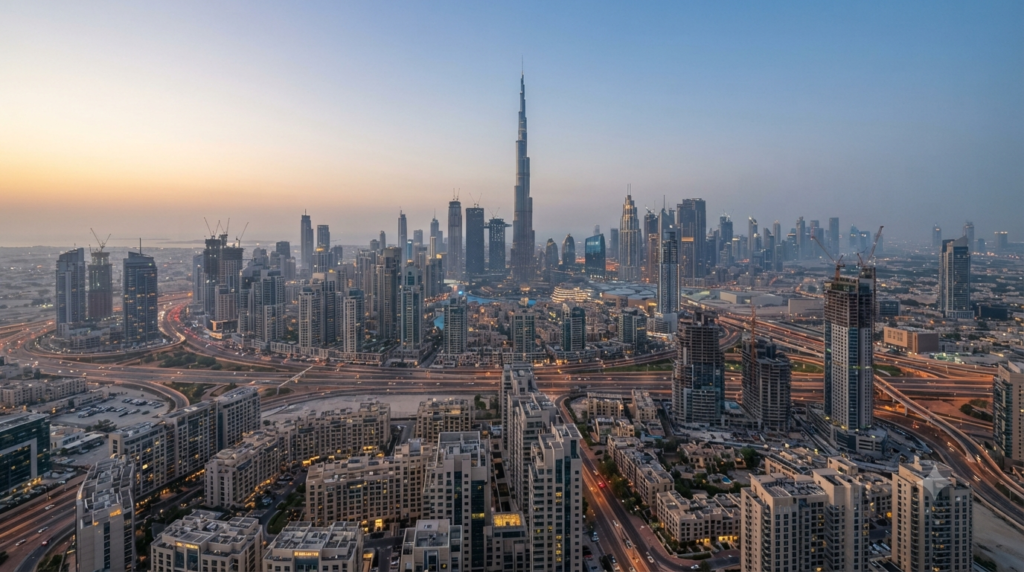
The gap between Dubai and traditional investment cities is not closing. It is widening. The reasons are structural, not cyclical.
Understanding these drivers helps Sydney investors see why global capital keeps flowing into Dubai.
Q1 2026 Market Data
The Dubai Land Department confirmed AED 252 billion in Q1 2026 transactions. That marks a 31% year-on-year increase across 60,303 deals. This is the strongest first quarter in Dubai’s history. Foreign investors contributed AED 148.35 billion, up 26% year on year. The number of foreign transactions rose 11% to 48,445 deals.
29,312 new investors entered the market for the first time, a 14% increase. Dubai is not recycling existing buyers. It is attracting entirely new capital.
Global Yield Comparison
The numbers below explain why global capital is choosing Dubai property investment over traditional markets.
| Indicator | Dubai | Sydney | London | New York | Singapore |
| Avg Gross Yield | 6 to 9% | 2.5 to 3.3% | 2.5 to 4% | 3 to 5% | 2 to 3.5% |
| Avg Price/sqft (USD) | $550 | $850+ | $1,500+ | $1,700+ | $1,200+ |
| Income Tax on Rent | 0% | Up to 45% | Up to 45% | Up to 37% | Up to 22% |
| Capital Gains Tax | 0% | Yes (CGT) | 18 to 28% | 15 to 20% | Yes |
| Annual Property Tax | 0% | Yes | Yes | Yes | Yes |
Dubai’s average apartment yield of 7.1% compares to 3% to 4% in London and 2% to 3% in Singapore. When you add zero tax to that equation, the net return gap becomes enormous.
Why the Yield Gap Keeps Growing
Dubai’s population surpassed 4 million in 2025. Growth exceeded 6% year on year. More people mean more tenants. More tenants means sustained rental demand.
Dubai’s government allocated over 46% of its 2025 budget to infrastructure. Metro expansions, airport upgrades, and smart city projects all drive long-term tenant demand. Population growth plus infrastructure investment equals rising rental income. That formula powers Dubai property investment returns.
Property Investment Compared to Sydney
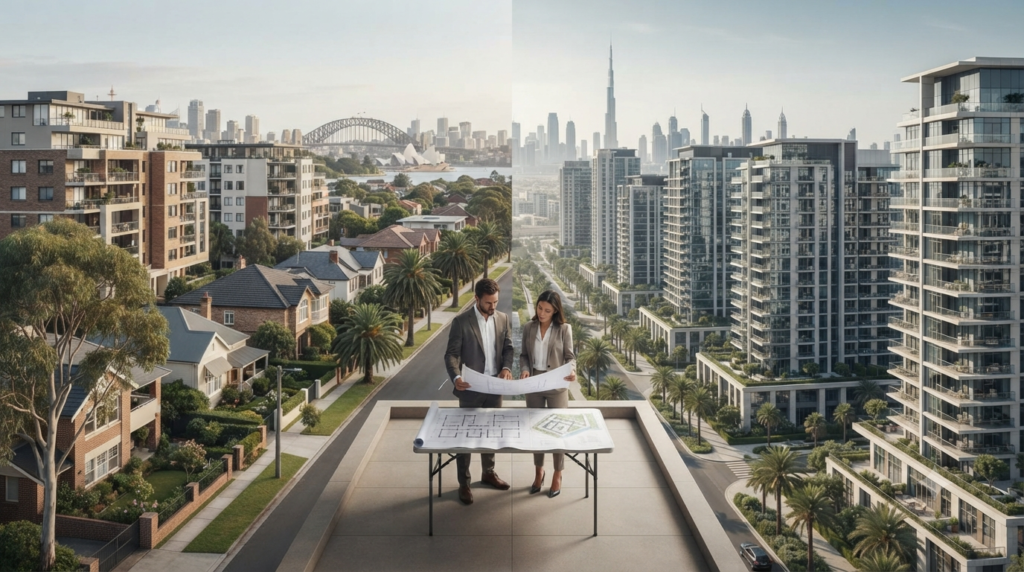
Sydney investors understand property. They know yields, holding costs, and tax implications. Putting Dubai next to Sydney in real terms makes the case clear.
From years of advising Sydney investors, this direct comparison is the moment most buyers move from curiosity to commitment.
Sydney’s Reality in 2026
Sydney’s median house price now exceeds AUD 1.76 million, according to CoreLogic. Gross rental yields average 3.3%. Net yield after strata, council rates, land tax, insurance, and management drops to around 2.3%.
A Sydney unit at AUD 800,000 earns approximately AUD 18,000 net annually. That is AUD 1,500 per month on a significant capital commitment.
Dubai’s Reality in 2026
A one-bedroom in JVC at AUD 400,000 earns AUD 22,000 to AUD 26,000 net annually. Zero rental tax. Service charges of AED 5 to AED 10 per sqft. Management fees of 5%.
Half the capital. Nearly 50% more income. No UAE tax on any of it.
Side-by-Side Investment Scenario
| Factor | Sydney Unit | Dubai One-Bed (JVC) |
| Purchase Price | AUD 800,000 | AUD 400,000 |
| Gross Annual Rent | AUD 26,000 | AUD 28,000 to 32,000 |
| Strata / Service Charges | AUD 6,000 | AUD 3,000 to 4,000 |
| Management Fee | AUD 2,400 | AUD 1,500 |
| Council Rates + Land Tax | AUD 3,500 | AUD 0 |
| Net Annual Income | ~AUD 14,000 | ~AUD 22,000 to 26,000 |
| Net Yield | ~1.75% | ~5.5% to 6.5% |
The gap is not marginal. It is the difference between a passive holding and a genuine income-producing asset. This comparison is why Sydney investors increasingly choose Dubai property investment.
Structural Advantages Drive Property Investment

Returns alone do not explain why 29,000 new investors entered in a single quarter. The structural framework behind those returns matters equally.
These advantages are policy-driven. They do not fluctuate with market sentiment.
Zero Tax Environment
Dubai charges no income tax on rental earnings. No capital gains tax on resale. No annual property tax on ownership. No inheritance tax on real estate.
A 7.5% gross yield in Dubai remains largely intact after costs. In London, a 5% yield can fall below 3% after taxation and charges. Over a 10-year hold, that difference compounds into tens of thousands of dollars in additional income.
For Sydney investors in the 37% or 45% marginal bracket, the tax savings on Dubai property investment are not marginal. They are transformative.
Freehold Ownership & Legal Clarity
Foreign nationals receive a government-issued title deed from the Dubai Land Department. Full ownership. No time limit. No local sponsor. RERA escrow accounts protect every off-plan deposit.
Over 60 freehold zones are open to Australian buyers. The regulatory framework rivals established Western markets in transparency and enforcement.
Golden Visa Residency
Dubai property investment of AED 2 million or more qualifies for a 10-year UAE Golden Visa. This covers your spouse and dependents. No minimum stay requirement. No employer sponsor.
This visa has shifted investor behaviour from short-term speculation to long-term asset holding. That stabilises demand and reduces market volatility.
These structural advantages create a stable foundation for long-term investment performance, helping Sydney investors benefit from both strong returns and a highly supportive ownership environment.
Risks Sydney Investors Should Know?
No investment delivers returns without risk. Acknowledging the risks is what separates informed investors from reckless ones. What we have consistently observed with Sydney investors is that preparation eliminates most downside.
Market Cycles and Moderation
Annual price appreciation has moderated to 3% to 6% in early 2026, down from 15% plus in 2024. Analysts characterise this as healthy moderation, a shift toward end-user driven transactions rather than speculative flipping.
Supply Pipeline Pressure
Around 120,000 new units are scheduled for delivery in 2026. This supply can soften rents in specific areas. JVC, Marina, and Dubai Hills maintain tight balances. Business Bay and Dubai South carry a higher inventory risk.
Area selection is the strongest risk mitigation tool. Our guide on the best areas for Sydney investors breaks down which communities perform strongest.
Currency and ATO Obligations
The AED is pegged to the USD. Stable, but the AUD/USD rate moves. Use forward contracts to manage conversion risk. The ATO requires a worldwide income declaration. Dubai charges nothing locally. No double taxation. But reporting obligations are non-negotiable. Our rental yield guide covers the tax details thoroughly.
These risks are manageable when Sydney investors focus on quality locations, maintain a long-term investment horizon, and understand their Australian tax and currency obligations before purchasing.
Who Is Investing and How Big Is the Capital Flow?
Understanding who else is in the market gives Sydney investors confidence that they are joining a verified trend, not chasing hype.
Global Buyer Profile (2025 to 2026)
| Nationality | Share of Foreign Purchases |
| Indian | ~22% |
| British | ~17% |
| Chinese | ~14% |
| Saudi | ~10% |
| Russian | ~9% |
| GCC, European, CIS | Balance |
Millionaire Migration Into the UAE
| Year | Net Millionaire Inflows | Estimated Wealth |
| 2022 | ~5,200 | ~US$33 billion |
| 2023 | ~4,500 | ~US$29 billion |
| 2024 | ~6,700 | ~US$43 billion |
| 2025 | 9,800 | US$63 billion (record) |
This diversity reduces dependence on any single economy. It creates stable, broad-based demand. And it confirms that Dubai property investment is a mainstream global strategy, not a niche play.
Ready to Join the Smart Money Moving into Dubai?
Dubai property investment gives Sydney investors what the local market cannot deliver: 6% to 9% gross yields, zero tax on income, Golden Visa eligibility, and entry from AUD 250,000. The Q1 2026 data is the strongest in Dubai’s history. The structural advantages are policy-driven, not hype-driven.
Over 29,000 new investors entered in a single quarter. Australians are among the fastest-growing segments. The opportunity is verified by transaction records, not marketing brochures.
Secure your free spot at dubaipropertyexposydney.com.au and take the first step toward Dubai property ownership from Sydney.
Frequently Asked Questions
Is Dubai property investment still worth it in 2026?
The data says yes. Q1 2026 recorded AED 252 billion in transactions, up 31% year on year. Rental yields remain 6% to 9% gross with zero income tax. Price growth has moderated to 3% to 6%, which analysts consider a healthy stabilisation rather than weakness. For Sydney investors earning 2.3% net locally, the yield differential remains substantial. A 5-year minimum hold continues to deliver strong results across every previous market cycle.
How much do Sydney investors need to start?
Entry-level off-plan studios in JVC and Dubai South start from AUD 200,000 to AUD 250,000. Interest-free payment plans require just 10% upfront. That means AUD 20,000 to AUD 25,000 secures a unit. No mortgage needed. No Australian bank involvement. The balance spreads across 3 to 5 years of construction milestones.
How does Dubai property investment compare to Sydney returns?
A AUD 400,000 one-bedroom in JVC generates approximately AUD 22,000 to AUD 26,000 in net annual income. An AUD 800,000 Sydney unit generates approximately AUD 14,000 net. Half the capital in Dubai produces nearly double the income. Zero rental tax in Dubai widens the gap further. The full buying process can be completed remotely from Sydney.
What are the biggest risks for Australian investors?
Market cycles, oversupply in specific areas, and currency fluctuation are the three main risks. Dubai prices moderated to 3% to 6% growth in early 2026. Around 120,000 new units are scheduled for delivery this year. The AUD/USD rate affects real returns when converting income. All three risks are manageable through area selection, a 5-year hold horizon, and specialist forex providers for currency management.
Where can Sydney investors explore Dubai property investment in person?
The Dubai Property Expo Sydney brings licensed developers to Australia multiple times per year. You can compare projects from Emaar, DAMAC, Binghatti, and Ellington side by side. Free consultations with advisors who understand the Australian investor framework are included. Visit the expo guide for details on upcoming 2026 events.