Quick Answer
- Dubai short-term rental investment delivers gross yields of 8 to 12%
- A Sydney couple reached a 9.1% net yield across three Dubai holiday homes
- DTCM holiday home permits cost roughly AED 1,500 per bedroom yearly
- Sydney caps short-term rentals at 180 days; Dubai allows year-round letting
- Occupancy in Dubai’s top holiday-home areas averages 75 to 85%
Dubai short-term rental investment delivers gross yields of 8 to 12% in tourist-heavy areas, roughly double what a standard long-term Dubai lease returns and well above Sydney’s compressed 3.1% average. One Sydney couple turned this into a 9.1% net yield across three holiday apartments in eighteen months, without leaving their home office.
Australian investors researching Dubai property investment broadly tend to land on short-term rental strategies specifically once they see the yield gap in writing. The rest of this guide walks through licensing, real numbers, global comparisons, and who this strategy actually suits.
This guide breaks down how the model works, what it actually costs, and whether it holds up against global alternatives.
What Is Short-Term Rental Investment?
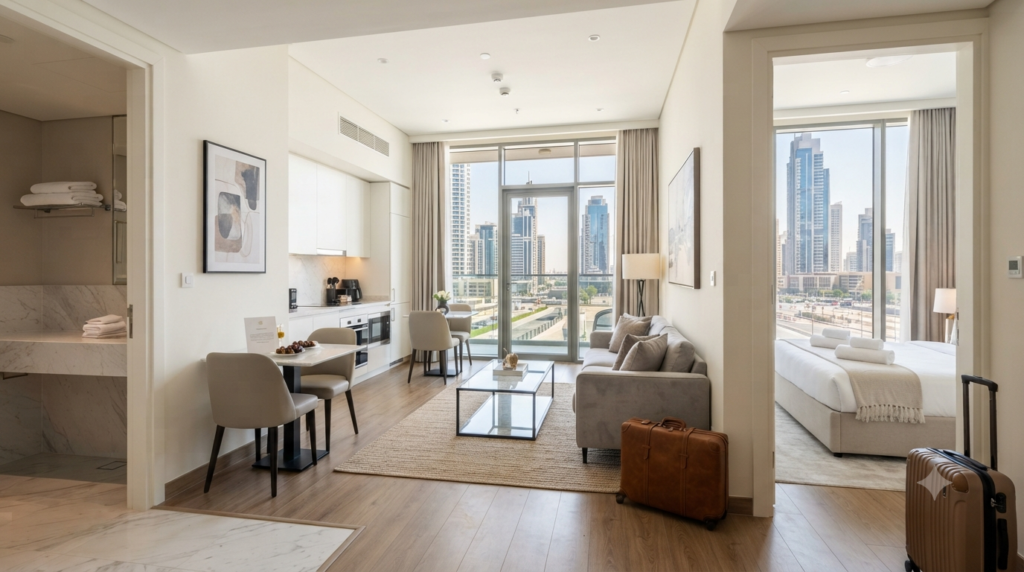
Dubai short-term rental investment means buying a property and letting it out on a nightly or weekly basis through platforms like Airbnb, rather than signing a standard 12-month lease. The Dubai Department of Economy and Tourism (DET) regulates the entire sector through a formal holiday home licensing system, published on the official Visit Dubai short-term rental investment tourism authority site.
Licensing Requirements
Every unit needs a DTCM holiday home permit before it can legally list on short-let platforms. Permits cost approximately AED 1,500 per bedroom per year, plus a 10% Dubai Tourism fee applied to each booking. Registration is handled through DET’s official portal and is generally quick for first-time investors, with most approvals completed within two to three weeks once documentation is submitted correctly.
Best Areas
Dubai Marina, Downtown Dubai, Business Bay, JBR, and Palm Jumeirah post the strongest short-let performance, with average daily rates between AED 400 and 1,200 depending on season. Best Areas to Buy Property in Dubai for Sydney breaks down entry prices for each of these communities in more detail, including which ones suit a first-time short-let buyer versus a scaling investor.
Licensing is straightforward once you know the steps, but it only tells you what’s legally possible, not what a unit will actually pay you. That comes down to the yield math, which is where Dubai short-term rental investment gets genuinely interesting for Sydney buyers.
How Much Can You Earn?
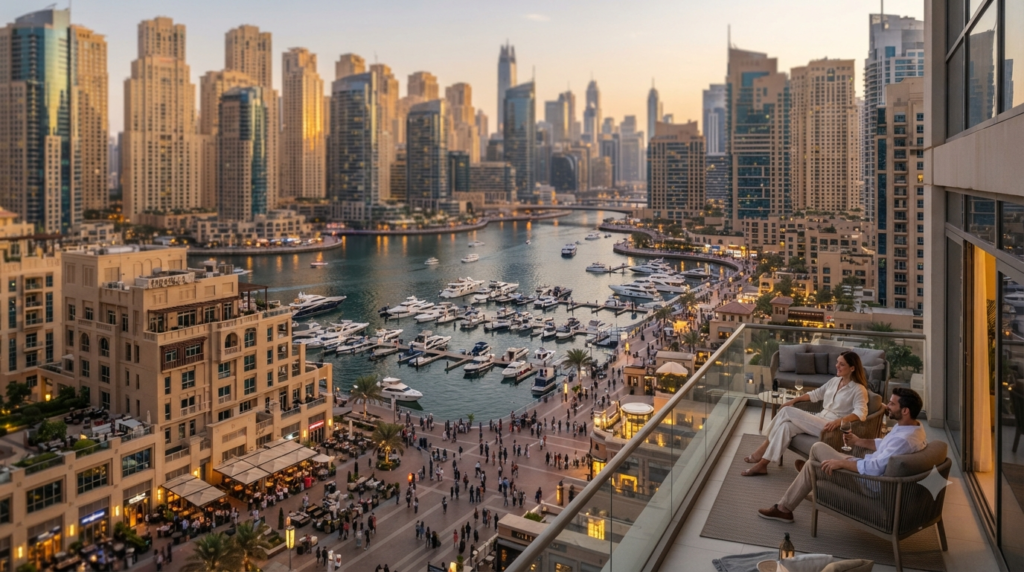
Returns vary sharply depending on whether you’re looking at the headline gross figure or what actually lands in your account.
Gross Yield Range
Dubai short-term rental investment in prime tourist zones commonly returns 8 to 12% gross, compared with 5 to 6% on a standard annual lease in the same building. Occupancy in these areas runs 75 to 85% across the year, supported by a tourism sector targeting 40 million hotel guests by 2031.
Net Yield Reality
Gross numbers rarely survive contact with real costs. Management fees for short-let operators run 15 to 25% of revenue, since these properties need active guest turnover, cleaning, and dynamic pricing that a long-term lease never requires.
- A 9% gross yield in JVC typically settles near 5.5 to 6.5% net
- Service charges range from AED 13 to 35 per square foot depending on the building
- Vacancy allowances of 20 to 25% should be budgeted even in strong areas
- Dynamic pricing tools can lift revenue 15 to 20% versus fixed nightly rates
| Area | Gross Yield (Short-Term) | Typical Net Yield | Service Charge Range |
| Jumeirah Village Circle | 8.5–9.5% | 5.5–6.5% | AED 13–15/sqft |
| Dubai Marina | 8.5–12% | 5.5–7% | AED 18–25/sqft |
| Business Bay | 6–8% | 4.8–5.6% | AED 15–20/sqft |
| Downtown Dubai | 4–6% | 3.2–5.5% | AED 25–35/sqft |
The gap between gross and net is exactly where most first-time investors get their numbers wrong. Seeing how a real Sydney-based portfolio performed against these same variables makes the math far easier to trust.
Real Sydney Investor Case Study

Chris and Laura, a Sydney couple in their late thirties, built a three-property Dubai holiday-home portfolio between late 2023 and mid-2025, motivated by rising interest rates squeezing their cash flow at home.
The Setup
They started with a single off-plan studio in Jumeirah Village Circle, priced at AED 780,000, before scaling into a Dubai Marina one-bedroom and a Business Bay two-bedroom using refinanced equity from the first unit. Off Plan Dubai Property: How Sydney Investors Get In Early covers how staged payment plans made this kind of scaling possible without fresh capital injections at every stage.
Their advisory team recommended an LLC structure in the Dubai Multi Commodities Centre free zone for liability protection and full foreign ownership, alongside a three-year investor visa allowing unlimited stays and a UAE bank account. Total upfront advisory and government fees came to roughly AED 65,400, rolled directly into the investment budget rather than paid separately.
The Results
Across the full AED 4.395 million portfolio, net operating income landed at 9.1% after management, utilities, and service charges. The couple now reinvests that income directly against their Sydney mortgage, shaving an estimated four years off the loan term.
| Property | Location | Price (AED) | Net Yield (Year 1) |
| #1 | Jumeirah Village Circle | 780,000 | 8.7% |
| #2 | Dubai Marina | 1,450,000 | 9.4% |
| #3 | Business Bay | 2,120,000 | 9.0% (projected) |
Their result sits comfortably inside the 8 to 10% net range that current supply and demand conditions still support for well-located units. That naturally raises the next question most Sydney investors ask before committing: how does Dubai short-term rental investment actually compare against other cities they could choose instead?
How Does Dubai Compare Globally?
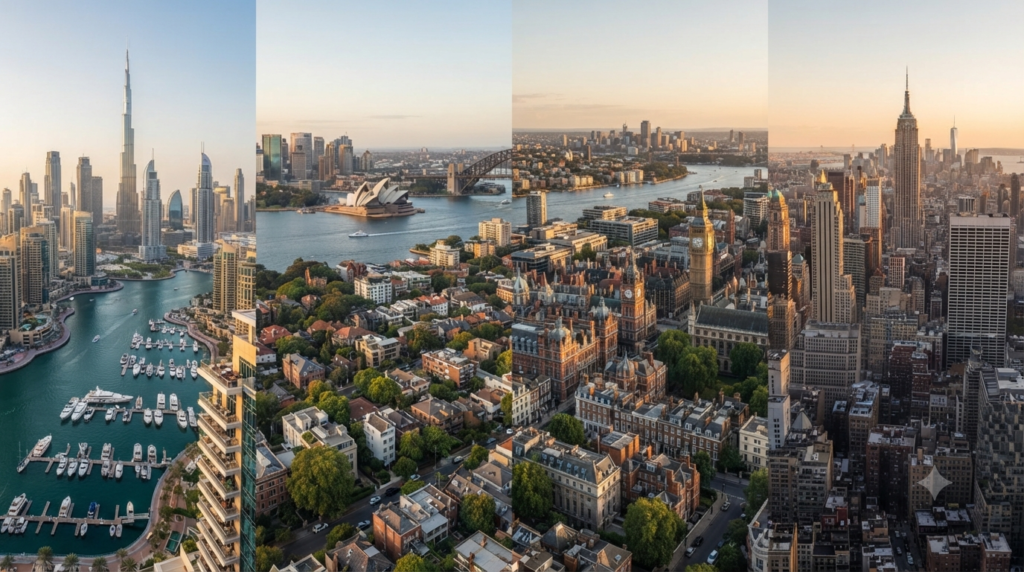
Sydney investors researching Dubai short-term rental investment usually cross-shop it against London, New York, and their own domestic market before committing capital.
Versus London Rules
London’s 90-day rule restricts short-let hosts to 90 nights annually without special planning permission, hard-capping earning potential regardless of demand. Central London gross yields also average just 3 to 5%, roughly half of what Dubai’s prime zones deliver with no seasonal restriction at all.
Versus New York Rules
New York’s Local Law 18 effectively bans rentals under 30 days unless the host is physically present, and requires formal city registration with heavy compliance overhead. This makes remote, hands-off short-term rental ownership essentially impossible in NYC, unlike the fully remote structure Chris and Laura used from Sydney.
Versus Sydney Caps
Sydney permits short-term rentals, but many council areas impose an 180-day annual cap alongside strict registration rules under state planning frameworks published by the NSW Government.
| City | Annual Night Cap | Gross Yield Range | Personal Income Tax |
| Dubai | None | 8–12% | 0% |
| London | 90 nights | 3–5% | Up to 45% |
| New York | Effectively banned <30 days | 2–4% | Federal + state + city |
| Sydney | 180 nights (most councils) | 3.1–4% | Marginal rate applies |
Every major comparison city carries some regulatory ceiling that Dubai simply doesn’t. That structural gap is really the core argument behind Dubai short-term rental investment for anyone currently boxed in by Sydney’s 180-day limit or considering a market with tighter rules still.
What Costs Reduce Your Yield?
Two line items consistently separate a good net return from a disappointing one, and both deserve honest budgeting before you commit.
Service Charges
Older Marina towers can charge up to AED 25 per square foot annually, while newer JVC developments sit closer to AED 13 to 15. On a 1,000 sq ft unit, that gap alone is worth roughly one to two percentage points of net yield, which compounds meaningfully across a multi-property portfolio as the one Chris and Laura built.
Management Fees
Full-service short-let operators charge 15 to 25% of gross revenue for guest communication, cleaning, and dynamic pricing. Is Dubai Investment Property Safe? covers how Dubai Land Department escrow protections apply regardless of which management model you choose, which matters most during the off-plan construction phase before any rental income starts.
| Cost Item | Typical Range | Frequency |
| DTCM holiday home permit | AED 1,500/bedroom | Annual |
| Dubai Tourism booking fee | 10% of booking value | Per booking |
| Management/operator fee | 15–25% of gross revenue | Ongoing |
| Service charges | AED 13–35/sqft | Annual |
These costs explain almost the entire gap between the headline number in a listing and what actually reaches your bank account. Once you’ve budgeted for both honestly, Dubai short-term rental investment becomes a very different, and more reliable, decision than the marketing figures alone suggest.
Does This Path Lead to Residency?
Many Sydney investors ask about residency benefits early, since Dubai property purchases can unlock more than just rental income.
Visa Thresholds
A three-year investor visa, similar to the one Chris and Laura secured, is typically available to property owners without a large minimum threshold, granting unlimited stays and a UAE bank account for receiving rental income directly in AED. For higher-value purchases, Dubai Golden Visa Property: The Complete Guide explains the AED 2 million threshold that unlocks a full 10-year residency for the buyer and their family.
Ownership Structure
Foreign investors can hold Dubai short-term rental investment property personally or through a free-zone LLC, each with different implications for liability and lending. Dubai Freehold Properties explains how 100% foreign ownership works in designated zones, which is the same freehold framework that made Chris and Laura’s LLC structure possible in the first place.
Residency is rarely the sole reason someone pursues Dubai short-term rental investment, but it’s a meaningful bonus layered on top of the yield case. Understanding both the visa pathway and the ownership structure upfront avoids surprises once you’re ready to scale beyond a single unit.
Who Should Consider This Strategy?
Dubai short-term rental investment isn’t the right fit for every investor, and being honest about that upfront saves time and money.
Ideal Investor Profile
This strategy suits Sydney investors with liquidity to spare, since construction progress payments can overlap if you scale quickly the way Chris and Laura did. It also favours buyers comfortable with active-style management, even when a professional operator handles day-to-day guest turnover on their behalf.
Key Risks to Weigh
Currency exposure matters too. Many investors convert 50% of net income to AUD quarterly using forward contracts to lock in exchange rates, keeping the remainder in AED for future purchases. Regulatory updates, like fire-safety certification requirements introduced in 2024, are also worth budgeting a small buffer for, since compliance windows can be tight.
Anyone comfortable with these trade-offs, rather than expecting a fully passive, zero-attention income stream, tends to get the most out of Dubai short-term rental investment over a multi-year horizon.
Ready to Start Earning From Dubai short-term rental investment?
A 9.1% net yield is achievable today for Sydney investors willing to follow the same structured approach Chris and Laura used: start with one unit, prove the model, then scale with refinanced equity rather than fresh capital. Dubai’s tourism base, backed by government infrastructure investment and a clear licensing framework, gives this strategy genuine staying power rather than a short-term trend.
Sydney’s own 180-day short-term rental cap and compressed long-term yields aren’t changing anytime soon, which is exactly why Dubai short-term rental investment keeps attracting more Australian buyers each year. The properties, licensing process, and management structure are all proven and repeatable for a first-time buyer, not just early adopters.
Explore current Dubai holiday-home opportunities at dubaipropertyexposydney.com.au and book a free consultation to map out your own numbers.
Frequently Asked Questions
Do I need to be in Dubai to manage a short-term rental?
No. A notarised Power of Attorney lets your management company or advisor handle settlement, bank account setup, and key collection on your behalf. Most Sydney-based investors, including Chris and Laura, complete the entire process remotely after one optional trip to inspect properties and sign incorporation documents. Ongoing bookings, cleaning, and guest communication are typically handled by a licensed property manager under a shared reporting portal, with updates arriving via regular statements rather than requiring hands-on involvement.
How is short-term rental income from Dubai taxed for Australians?
Dubai charges zero personal income tax on rental earnings, but Australian residents must still declare this income on their ATO return as foreign income. A foreign income tax offset generally applies if any UAE-level charges were withheld, though currently none are on residential rent, so most investors end up paying tax at their normal Australian marginal rate on the net figure after eligible deductions.
What yield can I realistically expect from a Dubai holiday home?
Gross yields in prime tourist areas typically run 8 to 12%, while net yields after management and service charges usually settle between 5.5 and 9%, depending on the building and operator chosen. The Sydney case study in this guide achieved 9.1% net across a three-property portfolio over eighteen months. Individual results vary significantly based on location, furnishing quality, and how actively the property is managed.
Is it hard to get a short-term rental permit in Dubai?
No, the DTCM holiday home permit process through Dubai’s Department of Economy and Tourism is straightforward and typically completed within two to three weeks. Costs run around AED 1,500 per bedroom annually, plus a 10% booking fee collected by Dubai Tourism on each reservation. Most investors have their management company handle the entire application on their behalf as part of the standard onboarding process.
What happens to returns if Dubai Tourism slows down?
Units can generally pivot to standard 12-month leases if short-let demand softens, though at a lower yield of around 5 to 6% compared to the short-term alternative. Conservative stress-testing at 60% occupancy has still shown net yields holding near 6%, well above Sydney’s typical long-term average. This flexibility is one reason short-term rental investors treat Dubai as lower-risk than single-strategy markets like London or New York, where regulatory caps remove that fallback option entirely.