Quick Answer
-
Check the developer's active RERA registration on the Dubai REST app before anything else
-
Verify the project has its own separate RERA permit number on all documents
-
Confirm a dedicated escrow account exists at a DLD-approved bank for that project
-
Look at completed projects, delivery history, and independent buyer reviews
-
Walk away if any document, payment account, or RERA status does not match the registry
Sydney investors are committing serious money to Dubai off-plan property. On an AED 2 million apartment, you may hand over AED 400,000 — roughly AUD 165,000 — before the building is even halfway finished. That kind of exposure means one bad developer decision can cost you more than a year of savings before a single brick is laid.
The good news is that Dubai has one of the most structured developer registration systems in the world. Every legitimate developer must be registered with RERA — the Real Estate Regulatory Agency — and every off-plan project needs its own approval before a single unit can be marketed or sold. The tools to verify both are free, public, and take less than ten minutes to use.
This guide walks you through exactly how to check if a Dubai property developer is legit before you commit any money. You will learn how to check RERA registration, how to confirm an escrow account, which red flags to watch for, and what to do if something does not add up.
What Is RERA Registration?
Dubai's property market is regulated by RERA, which sits under the Dubai Land Department. Established under Law No. 16 of 2007, RERA's job is to license developers, register projects, and make sure buyer funds are protected throughout the construction process. No developer can legally market or sell property in Dubai without an active RERA registration.
RERA Registration Basics
Every developer in Dubai must hold a current RERA Developer Registration Number. This is separate from their trade licence. A developer can hold a valid trade licence and still have an expired RERA registration — which means they are not authorised to sell property.
Three statuses appear in the registry:
-
Active — the developer is currently registered and authorised to sell
-
Expired — the registration has lapsed; they cannot legally sell until they renew
-
Suspended — RERA has taken enforcement action, and the developer is barred from operating
Only Active means proceed. If you see Expired or Suspended at any point in your checks, stop the process and seek legal advice before going further.
The registration status matters because it ties directly to RERA's oversight requirements. An Active developer must maintain a dedicated escrow account, submit construction progress reports, and participate in the dispute resolution process. A developer with a lapsed registration operates outside that framework, and your payments would not carry the same legal protections under UAE law.
Project Permits Explained
A developer's own RERA registration is not enough on its own. Every individual off-plan project also needs its own RERA project permit before a single unit can be marketed or sold. The permit number must appear on all marketing materials, on the Sales and Purchase Agreement (SPA), and in the project's registry profile.
If a developer cannot provide a valid project permit number when asked, or if the number does not match the DLD registry, that is a serious warning. A legitimate developer will share this number without hesitation because it is a standard requirement they meet before going to market.
Project permits are issued per development, so a well-established developer with ten active projects holds ten separate permit numbers. Each one is publicly trackable and shows the project's expected completion date, current status, and escrow account details.
Checking Status Online
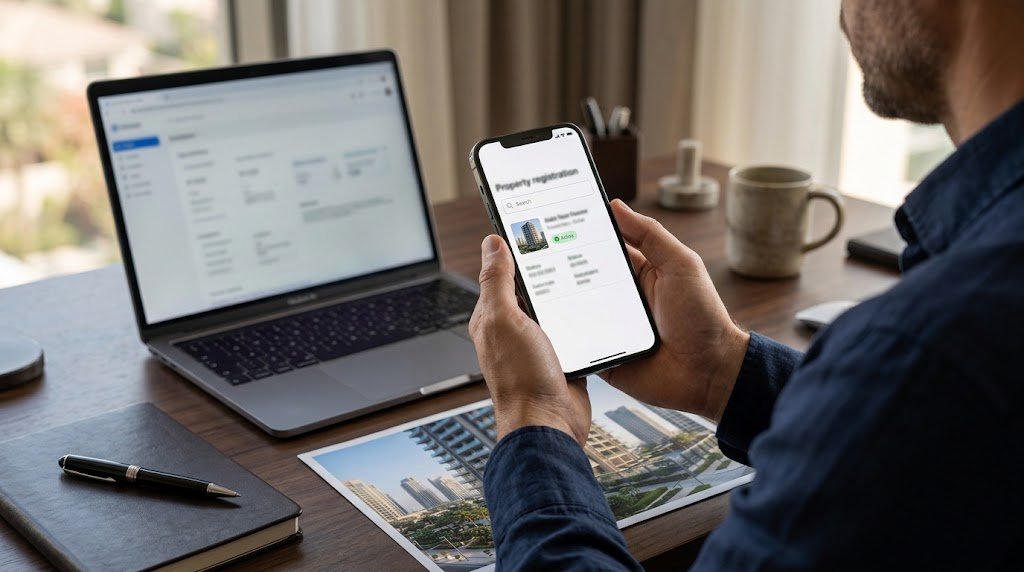
The fastest way to verify both the developer registration and the project permit is through the Dubai REST app — the DLD's official mobile platform. You do not need an account for basic searches. Navigate to Real Estate Services, then Registered Developers, and search by developer name or registration number. For the project itself, use the Project Inquiry section and search by project name or permit number.
You can also use the DLD's online portal in the Brokers and Developers section, or call the DLD directly on 800-4488 for written confirmation. The app reflects the current registry in real time. After doing these checks, you will have a clear picture of whether the developer and the project are both authorised before you take any next step.
How to Verify the Escrow Account
The escrow account is the central financial protection for off-plan buyers in Dubai. Under Law No. 8 of 2007, every off-plan project must have a dedicated escrow account at a RERA-approved bank. All buyer payments go into that account — not the developer's operating account, not a personal account, and not an offshore entity.
For Sydney investors putting large sums into a project they cannot physically visit, the escrow structure removes a significant layer of risk from the transaction.
The table below summarises the key rules set by Law No. 8 of 2007 as confirmed by Dubai Land Department enforcement data.
|
Escrow Rule |
Detail |
|
Account type |
Dedicated per-project account at a RERA-approved bank |
|
Fund access |
Developers cannot access funds freely; withdrawals are tied to verified construction milestones |
|
Milestone verification |
A RERA-appointed independent auditor confirms construction progress before any release |
|
Land requirement |
Developer must own the land or hold a valid long-term lease before an escrow account can be opened |
|
Fund protection |
If RERA officially cancels a project, escrow funds are ring-fenced for buyer refunds |
The escrow rules were tightened significantly after the 2008–2009 property downturn, when several Dubai developers stalled or abandoned projects.
The current structure means your stage payments — which are tied to the payment plan milestones in your SPA — sit in a protected account that can only be drawn down as verified construction milestones are reached, not whenever the developer wants access to cash.
Finding Escrow Details
The escrow account details for any registered off-plan project are visible in the Dubai REST app under the project profile. The details include the bank name and the escrow trustee. Before you sign anything, look up the project and record these details.
When you receive your SPA, the escrow account number in the document must match what appears in the RERA registry. If the numbers do not match, or if the SPA references a different bank, do not proceed until you have resolved the discrepancy with a UAE-qualified real estate lawyer.
This discrepancy is one of the most common ways that fraudulent transactions begin. Legitimate developers welcome the check because it confirms their compliance.
You can also call the escrow trustee bank directly to confirm the account is active and linked to the specific project. A five-minute call to the bank's real estate division adds a second independent layer of verification that costs nothing and can prevent a very expensive mistake.
Payment Rules to Follow
The core payment rule is this: never transfer funds to any account other than the registered escrow account for that specific project. This covers personal bank accounts, company operating accounts, crypto wallets, offshore entities, and any account where the name or number does not exactly match what is in the RERA registry.
-
All payments must go to the project's registered escrow account only
-
Match the exact account number in your SPA against the RERA registry entry before any transfer
-
Call the escrow bank directly to confirm the account is active before sending money
-
Keep a record of every transfer: account name, account number, bank confirmation, and timestamp
Payment diversion is one of the most common fraud patterns targeting overseas property buyers. A fraudster intercepts communication between the buyer and the developer and replaces the bank details with their own account.
Because the amounts are large and buyers are often transferring internationally for the first time, this is hard to detect without an independent bank call. That one step closes the gap.
After confirming the escrow account, you have completed the compliance checks. The next part of your verification looks at whether this developer actually delivers on what they promise.
Assessing the Developer's Track Record
Registration and escrow checks confirm a developer is authorised and compliant. They do not tell you whether the developer actually delivers. Track record checks give you the picture the registry cannot: how long projects take, what buyers say when they move in, and whether the finished product matches what was marketed.
The table below — based on analysis from SBA Properties and publicly available DLD data — outlines the tiers most Australian investors will encounter.
|
Developer Tier |
Examples |
Key Characteristic |
|
Government-linked |
Emaar, Nakheel, Dubai Holding (Meraas) |
Publicly listed or government-backed; strong delivery history |
|
Established private |
DAMAC, Sobha Realty, Aldar |
Significant portfolio; some delays recorded in past downturns |
|
Growing mid-size |
Ellington, Binghatti, Azizi |
Newer or smaller; project-level checks especially important |
Even government-linked developers require project-level verification. The tier tells you the baseline risk, not the outcome for the specific tower you are buying into.
Checking Delivery History
Start with the developer's own website and look for a completed projects section. Note how many developments they have finished and whether advertised handover dates matched when buyers actually received their keys. Independent property forums, Dubai-focused Reddit communities, and review sections on Property Finder and Bayut carry buyer feedback that is difficult to manipulate at scale.
The RERA Tracker at reratracker.com shows construction completion percentages for off-plan projects and lets you compare the developer's claimed progress against independently tracked figures.
If a developer requests payment at 40% completion but RERA Tracker shows 25% completion, raise that discrepancy before you transfer anything. You can also search for DLD penalties and RERA enforcement actions through the DLD portal — developers with formal enforcement history are listed, and their history is publicly accessible.
The track record check closes an important gap. A developer can be fully registered and compliant today and still have a poor delivery history. Combining the compliance checks with the track record check gives you a complete picture of both legal standing and practical performance.
Red Flags in the Record
The following red flags are based on verified patterns from RERA's enforcement data. The complaints process handled over 3,800 cases in 2025, according to DLD figures.
-
No completed projects at all — no delivery history means no track record to evaluate
-
Multiple projects with significant delays relative to original handover dates
-
Pressure to sign immediately without time for due diligence
-
Reluctance to share the SPA for independent legal review before signing
-
Guaranteed return claims or fixed appreciation promises — UAE law does not permit guaranteed ROI on property
-
Recent ownership changes or rebranding with no explanation
None of these automatically makes a developer fraudulent. But any one of them should slow you down and trigger a deeper check before you commit money. A legitimate developer's reputation holds up under scrutiny. If questions are met with evasion rather than documentation, that response tells you what you need to know.
The track record section is where many overseas buyers find their clearest signal. A developer who has delivered fifty buildings on time will have fifty buildings' worth of buyer reviews, forum posts, and DLD records to confirm it. A developer who has delivered nothing will not.
Pre-Signing Verification Checklist
Before you sign any SPA for a Dubai off-plan property, run through this checklist in order. Each step builds on the last, and skipping one leaves a gap that fraud or error can exploit. Sydney investors buying through the biggest Dubai property developers will still benefit from running through every step independently.
|
Step |
Where to Check |
What to Look For |
|
Developer RERA registration |
Dubai REST app → Registered Developers |
Status shows "Active" |
|
Project permit |
Dubai REST app → Project Inquiry |
Permit number matches marketing materials and SPA |
|
Escrow account details |
Dubai REST app → Project profile |
Bank name and trustee listed; matches SPA |
|
Escrow bank confirmation |
Call the escrow bank directly |
Account active and linked to this specific project |
|
SPA review |
UAE-qualified real estate lawyer |
Unit details, payment schedule, handover date, late-handover penalties, defect liability, refund terms |
|
Oqood registration |
DLD registration confirmation |
Certificate shows your name, unit number, floor, building, price, and registration date |
Oqood is the DLD's interim registration system for off-plan units. It is the official record that you are the buyer of a specific unit in a specific project. Any suggestion that Oqood registration is optional, will happen later, or is automatic without you receiving a certificate is a serious warning sign.
Running the full checklist from RERA registration through to Oqood confirmation is the complete process — and it is a process that any trustworthy developer will support without friction.
What to Do If Something Goes Wrong
If you have already committed money and something does not add up — payment requests go to a non-escrow account, the project status has changed, or the developer will not confirm escrow details — there is a formal complaints process through RERA that is fully accessible to overseas buyers.
RERA processed over 3,800 complaints in 2025. Filing fees run approximately AED 500 to AED 1,000, depending on claim value, and the fee is refundable if you win. Many disputes resolve through mediation within 15 to 30 days. Straightforward investigations typically conclude within two to four weeks.
RERA can impose fines on developers ranging from AED 50,000 to AED 1,000,000. Additional enforcement options include licence suspension, project freezes, blacklisting, and criminal referral to Dubai Police and the Public Prosecution. The system has real teeth, and overseas buyers have the same access to it as UAE residents.
If your situation involves suspected fraud — a stolen deposit, forged documents, or payment diversion — file a parallel criminal complaint with Dubai Police at the same time as your RERA complaint. The Dubai Police eCrime portal accepts international reports online if you are filing from Australia. You can also contact the ATO for guidance on any Australian tax implications if funds have already been transferred offshore in connection with a disputed transaction.
Conclusion: Verify Before You Commit
Checking if a Dubai property developer is legitimate takes less time than most Sydney investors expect. The tools are free, publicly accessible, and built for buyers doing due diligence from thousands of kilometres away. A real developer with an Active RERA registration, a valid project permit, and a confirmed escrow account has nothing to hide and will answer every question clearly.
Before you sign anything or transfer any money, run the verification checklist in this guide. Visit Dubai Property Expo Sydney to speak with someone who can walk you through the process from start to finish.
Frequently Asked Questions
How do I check if a Dubai developer is RERA registered?
Open the Dubai REST app and go to Real Estate Services, then Registered Developers. Search by developer name or registration number. A legitimate developer shows as Active in the registry. You can also check through the DLD website at dubailand.gov.ae or call 800-4488 for written confirmation.
What is a RERA project permit and why does it matter?
A project permit is a separate approval that every off-plan development needs before units can be marketed or sold. It is issued per project, not per developer. The permit number must appear on all marketing materials and in the SPA. Checking it against the DLD registry confirms the project itself is legally authorised — not just the developer.
What happens to my money if the developer cancels an off-plan project?
Under Law No. 8 of 2007, escrow funds are ring-fenced per project. If RERA officially cancels a development, the escrow funds in that account are used to refund buyers. This protection only applies when your payments went to the registered escrow account — not to an operating account or any other account.
Can a Sydney investor access RERA's complaints process from Australia?
Yes. You can file a RERA complaint through the Dubai REST app or through the DLD website from anywhere in the world. There is no requirement to be physically present in Dubai. Filing fees are approximately AED 500 to AED 1,000 and are refundable if you win. For fraud cases, the Dubai Police eCrime portal accepts international reports.
What are the biggest red flags when checking a Dubai off-plan developer?
The clearest warning signs are no RERA registration, a suspended or Expired status, no dedicated escrow account for the project, payment requests to any account other than the registered escrow, and a permit number that cannot be verified in the DLD registry. Pressure to sign immediately without allowing time for due diligence is also a serious red flag regardless of how legitimate a developer appears on paper.